
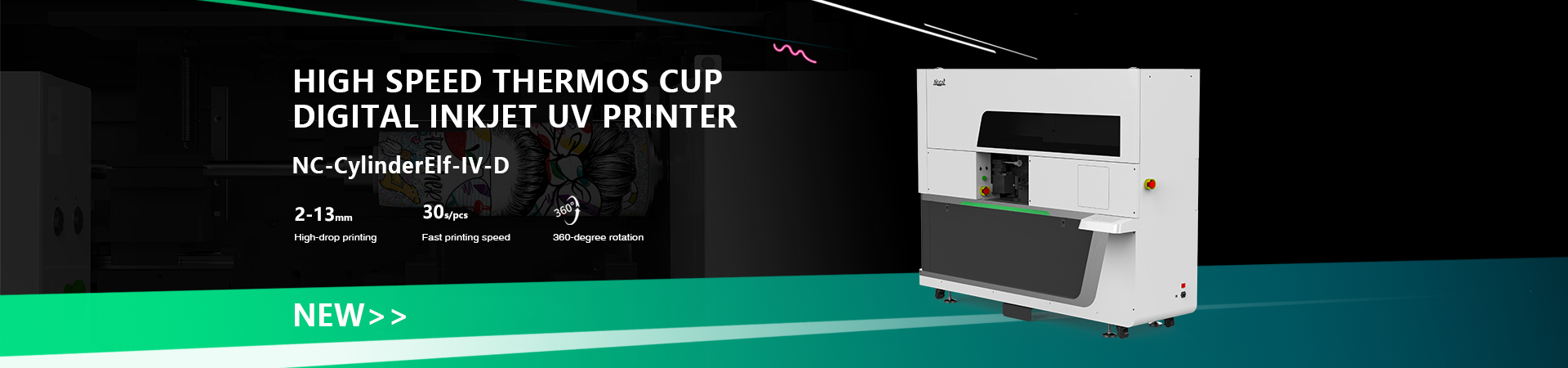
Beyond Flat Surfaces: Unlock New Possibilities with Cylindrical Printing
If you still think printers can only handle flat surfaces, this might change your perspective.
Most printers on the market—whether desktop inkjet or industrial UV—are designed for flat materials. But in reality, many products are cylindrical: tumblers, wine bottles, thermos cups, cans, speaker covers, and more.
Traditionally, decorating these items meant screen printing, pad printing, or labeling. Each comes with limitations:
- Screen printing: high setup cost, slow design changes
- Pad printing: limited color performance
- Labels: visible edges, lower perceived quality
That’s where cylindrical printers come in.
How does a cylindrical printer work?
The concept is straightforward: it combines UV printing with a rotary system.
The cylindrical object is fixed onto a rotating axis. While the printhead moves horizontally, the object rotates in sync. Ink deposition is precisely timed, allowing graphics to wrap seamlessly around the surface.
With UV ink curing instantly, the results are:
- Vibrant colors
- Strong adhesion
- Scratch resistance
From gradient designs on glass to high-precision logos on metal tumblers, everything can be printed in one pass.
What can it be used for?
Cylindrical printing covers a wide range of applications:
- Packaging
Custom wine bottles, tea cans, and beer cans. Ideal for small batches and multiple designs without high setup costs.
- Gifts & personalization
Thermos bottles, sports bottles, customized with photos, logos, or seasonal graphics—perfect for the growing personalization market.
- Stationery & daily items
Pen holders, spray bottles—small items that benefit from higher quality and efficiency compared to pad printing.
- Industrial components
Tubular parts or bearing sleeves that require surface markings like specifications or branding.
What problems does it solve?
Before cylindrical printing, customizing round objects came with several challenges:
- High minimum order quantities
Screen printing setup costs make small orders impractical.
- Expensive design changes
Each new design requires a new screen.
- Limited print quality
Pad printing struggles with gradients, fine text, and photo-quality images.
- Low efficiency
Manual labeling is slow and inconsistent.
Cylindrical printing eliminates all of these:
- No plate-making
- Direct digital printing
- Unlimited design changes
- Print-on-demand, even for a single piece
For factories focused on customization or small-batch production, it essentially adds a flexible new production line.
What should you consider?
Of course, not every cylindrical object is automatically printable. Key factors include:
- Diameter and length range
- Shape (e.g., tapered bottles may require special fixtures)
- Surface compatibility with UV ink
Before purchasing, it’s always recommended to test real samples to confirm print quality and production efficiency.
Final thoughts
Flatbed printing serves large-scale, standardized production. Cylindrical printing fills the gap for irregular shapes and customization. They don’t replace each other—they complement each other.
If you’re working with cylindrical products or expanding into personalized gifts and packaging, a cylindrical printer is well worth exploring.
Wrapping a full design seamlessly around a curved surface used to be complex and costly. Today, it’s simple—and accessible.
02.jpg)
